
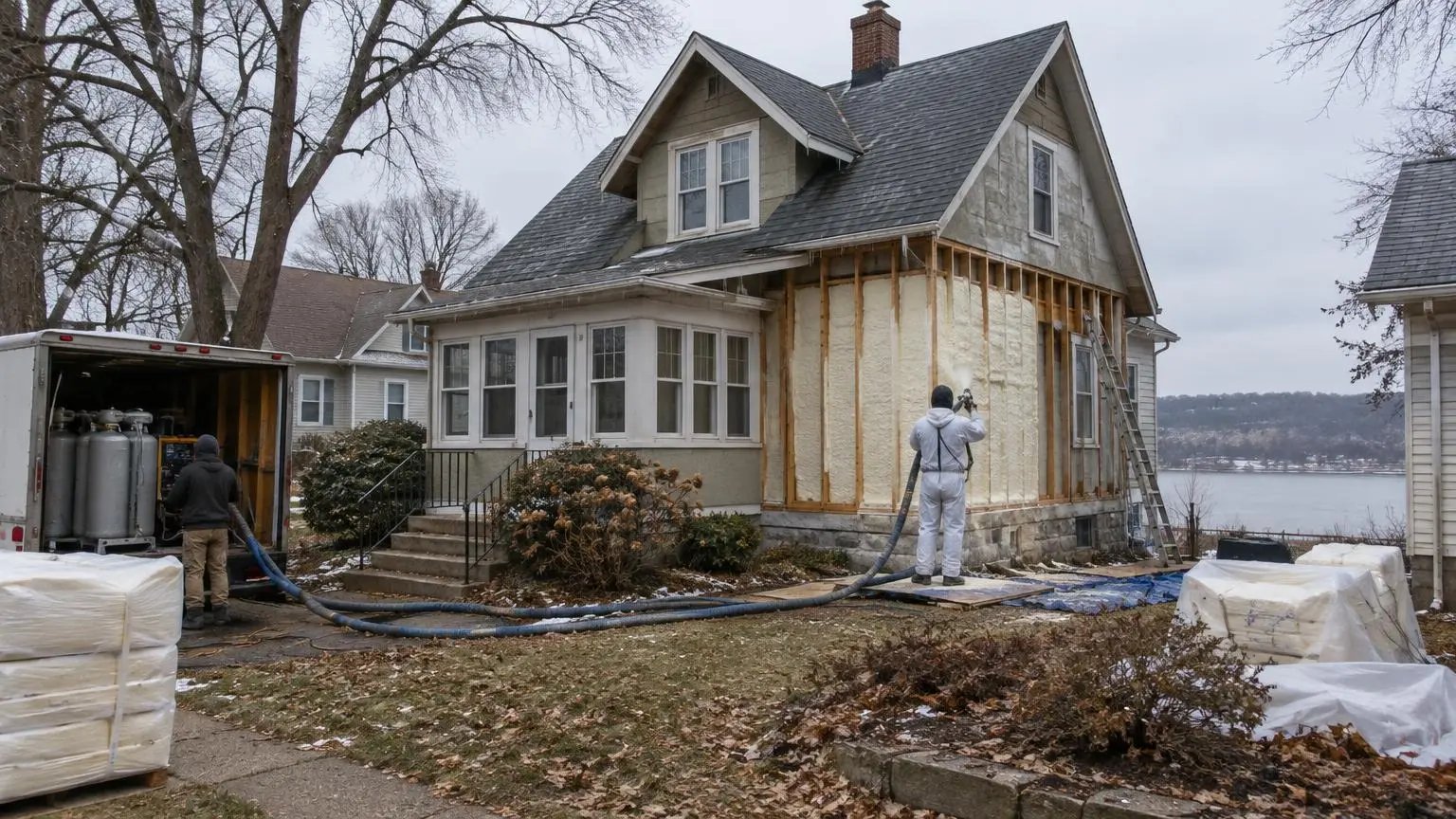
Older houses, long winters, east metro suburbs
Spray Foam Insulation in St. Paul, MN
Air sealing and insulation for St. Paul homes, from 1910s foursquares to newer suburban builds, priced in writing after we see the house.
- Free on-site estimates
- Written quote with material, depth and R-value for each area
- Air sealing done before any insulation covers it
Insulation Work Built Around a St. Paul Winter
Spray foam insulation in St. Paul has a lot of old houses to deal with. Census survey estimates for 2019 to 2023 show that 41.6% of the city's homes were built in 1939 or earlier, and the median home dates to 1952. Many of those houses went up with empty walls, a few inches of attic insulation and no air sealing at all. We are an insulation company that seals and insulates them, using closed-cell or open-cell spray foam where it earns its cost and blown-in insulation where that does the job for less.
Why the cold matters here
The Minneapolis-St. Paul area has the coldest average annual temperature of any major metro in the continental U.S., 46.5 F according to the city's Wikipedia climate section. At the St. Paul Downtown Airport the 1991-2020 normal high in January is just 23.9 F, and the record low is -41 F. A house that leaks warm air at the attic floor and the rim joist pays for it every day from November through March, and the same leaks feed the ice dams and attic frost that show up on so many older roofs.
What Minnesota code and the DOE ask for
Ramsey, Washington and Dakota counties are in Climate Zone 6 under Minnesota's energy code. The efficientwindows.org summary of that 2012 IECC-based code lists R-49 for ceilings, R-20 plus R-5 continuous (or R-13 plus R-10) for wood-frame walls, R-30 for floors and R-15/19 for basement walls in Zone 6. DOE's Energy Saver guidance for existing homes in zones 6 and 7 suggests R-49 to R-60 in an attic. Code applies to new work and permitted remodels, so for a project in an existing house we start with those numbers and then fit them to the framing you actually have.
Closed cell vs open cell
Closed-cell foam is dense and rigid, carries more R-value per inch, and slows moisture as well as air. That makes it the usual choice for rim joists, basement walls, cathedral ceilings with shallow rafters and anywhere foam meets cold concrete. Open-cell foam is soft, lighter and less expensive per inch. It fills odd cavities well and quiets sound, but it lets vapor pass, so in a Minnesota roof or wall it needs a vapor control plan. Many jobs use both, plus loose fill in the open attic. Your quote names which one goes where.
Costs, in plain numbers
National cost guides put installed spray foam at roughly $1.50 to $5.00 per square foot (HomeGuide), with open cell at the low end and closed cell at the high end. HomeGuide lists a typical attic insulation job at $1,000 to $2,700 and spray foam on rim joists at $2,000 to $2,500. Many spray foam contractors also have a job minimum, which HomeGuide puts at $1,000 to $2,000 or more. Those are national ranges. Your price is the one on the written estimate we give you after the visit.
Rebates worth checking first
Xcel Energy's 2024-2026 Minnesota rebate summary lists 40% of project cost, up to $1,200, for attic insulation that goes from R-19 or less to R-49 or more, and the same 40% (up to $1,200) for filling empty wall cavities to R-11 or better. Air sealing is paid at 40% up to $600 when a blower door test shows at least a 15% drop in leakage, and the insulation rebates require that air sealing. Eligibility depends on who supplies your heat, so check the current rules before you sign anything. We can plan the work and the testing around them.
Choosing among spray foam insulation companies
When you compare insulation contractors near you, ask each one for the same things: the material for each area, the thickness or depth, the target R-value, what gets air sealed, how the foam will be covered where code calls for a thermal barrier, and how long you need to stay out of the house after spraying. A quote that lists all of that is easy to compare. A single number for "insulate house" is not. Get a free estimate
Where We Work
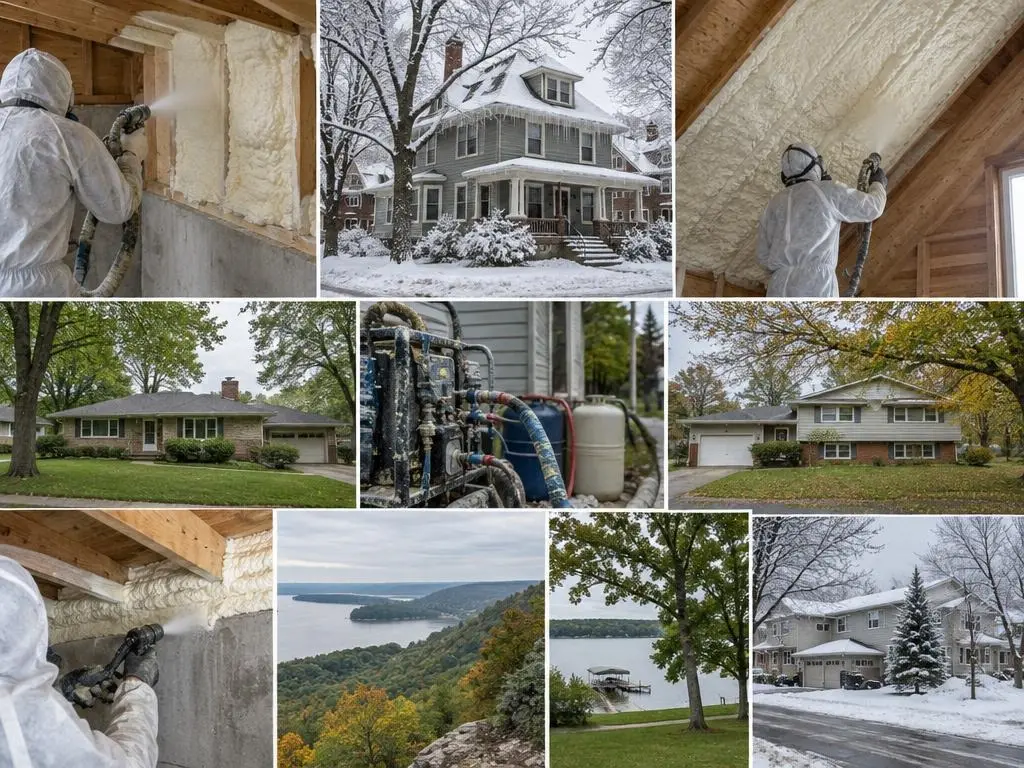
We work in St. Paul and across the east metro. In Ramsey County that means Maplewood, Roseville, North St. Paul, White Bear Lake, Shoreview, Vadnais Heights, New Brighton, Little Canada, Arden Hills and Falcon Heights. In Washington County we cover Woodbury, Oakdale, Lake Elmo, Mahtomedi, Cottage Grove and Stillwater. South of the river we work in West St. Paul, South St. Paul, Inver Grove Heights, Mendota Heights and Eagan. The housing changes a lot from one to the next: St. Paul and the river towns have the oldest homes, the inner-ring suburbs are full of 1950s to 1970s ramblers and split-levels, and places like Woodbury, Lake Elmo and Cottage Grove are mostly newer construction. Each town page covers what we see there and the local numbers behind it.
- Spray Foam Insulation in St. Paul, MN
- Spray Foam Insulation in Maplewood, MN
- Spray Foam Insulation in Roseville, MN
- Spray Foam Insulation in West St. Paul, MN
- Spray Foam Insulation in South St. Paul, MN
- Spray Foam Insulation in Inver Grove Heights, MN
- Spray Foam Insulation in Woodbury, MN
- Spray Foam Insulation in Oakdale, MN
- Spray Foam Insulation in North St. Paul, MN
- Spray Foam Insulation in White Bear Lake, MN
- Spray Foam Insulation in Shoreview, MN
- Spray Foam Insulation in Mendota Heights, MN
- Spray Foam Insulation in Eagan, MN
- Spray Foam Insulation in Cottage Grove, MN
- Spray Foam Insulation in Stillwater, MN
- Spray Foam Insulation in Vadnais Heights, MN
- Spray Foam Insulation in New Brighton, MN
- Spray Foam Insulation in Falcon Heights, MN
- Spray Foam Insulation in Little Canada, MN
- Spray Foam Insulation in Lake Elmo, MN
- Spray Foam Insulation in Mahtomedi, MN
- Spray Foam Insulation in Arden Hills, MN
Common Questions
What is the code for wall insulation in MN?
The Twin Cities counties are in Climate Zone 6 of Minnesota's energy code. The efficientwindows.org summary of the 2012 IECC-based code lists R-20 plus R-5 continuous insulation, or R-13 plus R-10, for wood-frame walls in Zone 6. That applies to new construction and permitted work; filling the walls of an existing house is judged by what the cavities can hold, and Xcel's wall rebate asks for R-11 or better in a previously empty cavity.
How much does spray foam insulation cost in St. Paul?
National guides put installed spray foam at about $1.50 to $5.00 per square foot, with closed cell costing more than open cell (HomeGuide). Rim joists commonly run $2,000 to $2,500 and whole-house projects $8,000 to $20,000 by the same guide. We price your house after measuring it, and the written estimate is what you pay.
Does spray foam insulation lower home value?
Not by itself. Some buyers and appraisers worry about foam sprayed on the underside of a roof deck because it can hide roof leaks, and a few lenders ask questions about it. Foam that is installed for a clear reason, with the product and location documented, is easy to explain at sale time. We give you that paperwork.
Why do some people call spray foam a red flag?
The concerns usually come from bad installs: foam mixed or sprayed wrong that smells, pulls away from framing or hides wet wood. Others come from foam on roof decks that makes roof inspections harder. Proper mixing, the right thickness per pass, ventilation during curing and a moisture check before spraying are what prevent those problems.
Is closed cell or open cell better for a Minnesota house?
It depends on the spot. Closed cell is the usual pick against cold concrete, on rim joists and in shallow rafters because it resists moisture and packs more R-value per inch. Open cell costs less per inch and works well inside walls and some attics when paired with a vapor control plan. Many houses get some of each.
Who makes spray foam insulation?
Spray foam is a two-part product made by a number of chemical manufacturers and sold to installers as matched A and B components. What matters to you is that the product suits the surface, is installed at the maker's rated thickness per pass, and is named on your quote. We tell you exactly which product we plan to use.
Can you insulate the walls of an old St. Paul house without tearing off plaster?
Usually, yes. Closed wall cavities are most often filled with dense-pack cellulose or fiberglass blown through small holes from outside or inside, then patched. We check for knob-and-tube wiring and blocked bays first, since both change the plan.
How long do I need to stay out after spray foam?
HomeGuide's guide says to plan on leaving for 24 hours or more, and the foam maker's instructions set the exact re-entry time. We ventilate the work area during and after spraying and tell you the time before the job starts.
Why Homeowners Call Spray Foam Insulation St. Paul
We see it before we price it
Every quote follows a visit to the attic, walls and basement, not a guess over the phone.
Air sealing comes first
Top plates, chases, light boxes and the rim joist get sealed before new insulation hides them.
The right material for each surface
Closed cell, open cell, cellulose or fiberglass, chosen for the spot and the moisture risk, with the reason written on the quote.
Quotes you can compare
Each line shows material, depth or thickness, target R-value and price, so you can hold it up against any other bid.
What We Insulate
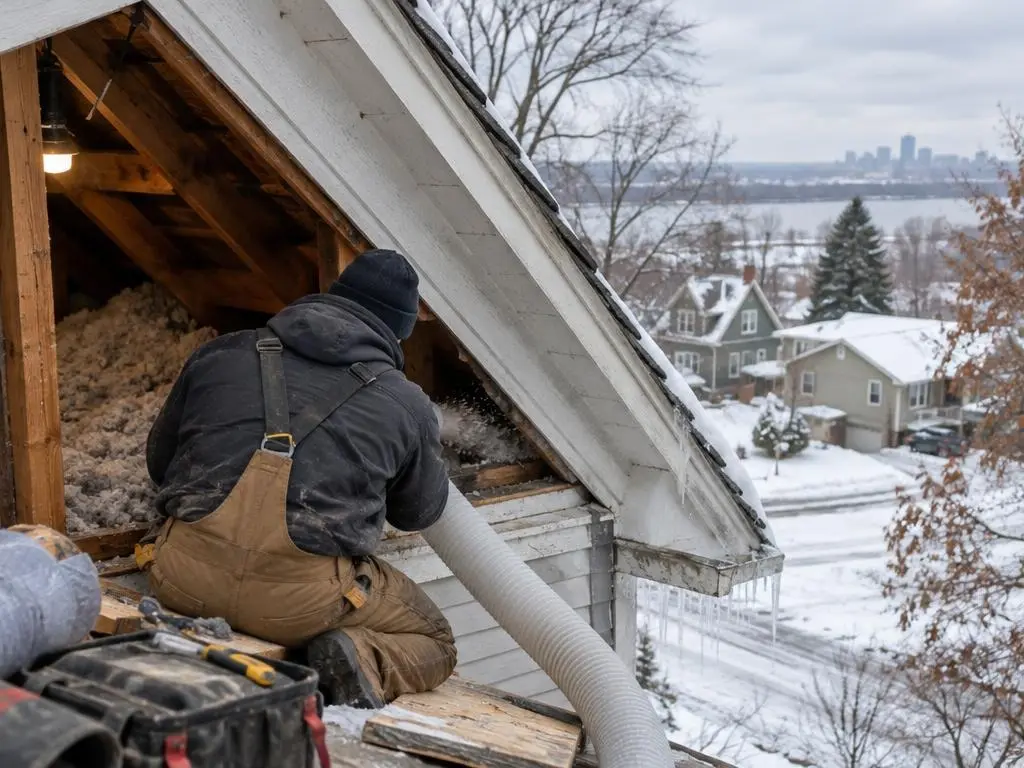
Six kinds of work, picked area by area for the house in front of us, from closed-cell foam on a rim joist to clearing out a soggy attic.
Spray Foam Insulation
Closed-cell and open-cell foam for the places loose fill cannot seal: rim joists, kneewalls, cathedral ceilings and cold concrete.
Learn more →Attic Insulation & Air Sealing
Seal the leaks that feed ice dams and attic frost, then bring the attic up to Zone 6 depth.
Learn more →Wall Insulation for Older Homes
Dense-pack fill for closed plaster walls, and foam for open walls during a remodel or addition.
Learn more →Basement & Rim Joist Insulation
Closed-cell foam on rim joists and basement walls, the coldest, leakiest band of most Twin Cities houses.
Learn more →Blown-In Insulation
Cellulose or fiberglass blown to depth over a sealed attic floor, the most cost-effective way to add R-value to an open attic.
Learn more →Insulation Removal & Replacement
Pulling out wet, moldy, rodent-soiled or failed insulation, then sealing and insulating the space right.
Learn more →Get a Spray Foam Insulation Estimate
We look at the attic, walls and basement, then send a written price for each area.